How Travel Likes Me Scaled from ₹0 to ₹10 Lakh a Month — 3 Orders in Week One, 247 Orders in Week Seven
Week one. Eighty people added a product to their cart. Three actually bought it. A 3.75% cart-to-purchase rate. Every rupee of ad spend generating ₹0.70 back. For a brand that had never run a paid campaign before, these numbers weren't just disappointing — they were a warning. Fix this now, or the whole experiment collapses before it begins.
Six weeks later, the same brand processed 247 orders in a single week. Then hit ₹78,000 in sales on one Tuesday in March. Then set an April revenue target of ₹19–20 lakh a month — across backpacks, towels, compression gear, and travel accessories that barely existed as a digital brand three months earlier.
This is the story of how Travel Likes Me went from zero D2C revenue to one of the most rapidly-scaling travel accessories brands in India.
BRAND SNAPSHOT
Industry: Travel Accessories (D2C)
Products: Ultra Nanofiber Towels, Premium Compression Backpacks, Compression Pockets, Travel Organizers, Toiletry Accessories, Neck Pillow with Massager
Geography: India (pan-India; Amazon + direct website)
Starting Revenue: ₹0 (zero D2C online history)
Milestone Achieved: ₹10L+/month; 247 orders in a single week; ₹78K single-day revenue
Services: Meta Ads, Google Ads, Creative Strategy, Website CRO, WhatsApp Abandoned Cart Recovery, Review Acquisition System, Funnel Optimization, Bundle Strategy
THE PROBLEM
Travel Likes Me had proof of product-market fit. Their Ultra Nanofiber Towels were already selling 100+ units a week on Amazon — the large size alone moved 76 units in a single week. Compression backpacks, travel organizers, and accessories were getting traction. The products were genuinely good.
But good products don't automatically build brands. Amazon was giving the brand sales — not customers. There were no first-party relationships, no email lists, no WhatsApp contacts, no website reviews, no repeat purchase infrastructure. Every order disappeared into Amazon's ecosystem. The brand had no D2C presence, no ad history, and no framework for finding which product could anchor a paid acquisition strategy.
The founder wanted to change that. But they'd never run paid digital ads before.
WHY IT WAS HAPPENING
Three compounding problems sat underneath the surface:
1. No performance infrastructure existed. No Meta pixel with meaningful data. No campaign history to learn from. No creative system, no testing framework, no performance baseline. When the first campaigns launched and generated 80 add-to-carts with only 3 purchases, there was no way to know if the problem was the creative, the landing page, the checkout flow, the product page, or all of the above.
2. The website wasn't built to convert paid traffic. Customers arrived, added to cart, and left. The product pages lacked benefit-led copy — features were listed, but not how those features changed a traveler's life. There was no social proof (no review widget installed). The checkout had no optimization layer. Abandoned cart recovery didn't exist. Every click the ad campaigns were paying for was leaking before it could convert.
3. No one knew which product would win online. The catalog was broad — backpacks at multiple price points, multiple towel sizes, compression pockets, water bottles, organizers, toiletry gear. Amazon data showed volume, but not creative angles or digital audience fit. The brand needed a systematic way to test multiple SKUs, identify the breakthrough product, and then build a catalog strategy around it — rather than betting everything on a guess.
THE SOLUTION
Conversion campaigns went live on December 19, 2024 — within days of onboarding.
Mythos — Creative Advantage: The creative team launched across multiple product lines simultaneously: backpacks, towels, compression gear, laptop sleeves. Within two weeks, a category-breaker emerged: the Ultra Nanofiber Towel. Not because it was the most promoted — but because it had the clearest problem-solution story. Travelers hate heavy, slow-drying towels. A towel that packs into your palm and dries in 15 minutes writes its own ad.
The team moved fast on the insight. They built on it — not by running the same ad repeatedly, but by testing hooks systematically. Lifestyle angles ("every hiker's secret weapon"), demonstration angles (packs into a fist, unfolds to full-size), and comparison angles (vs. cotton, vs. microfiber) were tested in parallel. When the founder shared that plastic compression bags sell ₹1.5 crore a month on Amazon alone, the creative team used that market intelligence immediately — repositioning the brand's premium compression gear as the natural upgrade from cheap plastic alternatives. Every product insight became a creative brief.
Sentinel — Scientific Media Buying: Daily performance reports were non-negotiable from day one. Not weekly summaries — daily breakdowns of ad spend, ROAS by campaign, cost per add-to-cart, conversion rates, and specific notes on what was winning and what was being cut. The founder wasn't left guessing. They knew exactly what was happening every morning.
Budget allocation was dynamic. Meta spend was scaled from ₹21,000/week in week one to ₹15,000/day by January 10 — but only where the data warranted it. When backpack ads underperformed while towel campaigns delivered 2.5–3x ROAS on winning creatives, budget was reallocated in real-time. No campaign ran past its useful life. The team ran a three-tier funnel architecture — top-of-funnel awareness, mid-funnel engagement, and bottom-of-funnel conversion — each tracked and optimized independently.
When Meta disabled the primary ad account in early February (no violation, no explanation — just Meta being Meta), the team escalated immediately. Within 48 hours the account was restored. In parallel, a backup ad account was set up — so if it happened again, campaigns would restart in hours, not days. The founder had been on track to hit a revenue target. The Arlox team made sure one platform hiccup couldn't derail it.
Vault — Brand Value Engine: The 3.75% cart-to-purchase rate in week one wasn't a demand problem — it was a funnel problem. The team prescribed a specific CRO action list: install a review widget (LOOX), activate Razorpay Magic Checkout for one-click payment, rewrite product descriptions as benefit-led bullet points instead of spec lists, add a proper size chart tool. These weren't suggestions — they were an operational checklist with deadlines.
Once the brand hit 20–30 orders a day, the team pushed hard on retention infrastructure. A ₹750 gift card incentive system was designed for review collection — customers who submitted a photo review received a gift card via WhatsApp for their next purchase. ConvertWay and Nitro were integrated for WhatsApp-first abandoned cart recovery, capturing and re-engaging ~40% of website visitors who had browsed without purchasing. Bundle products were created and tested — "Weekender Trip-Ready Travel Kit," "Tripper Travel System" — to increase AOV and reduce single-item dependency.
THE RESULTS
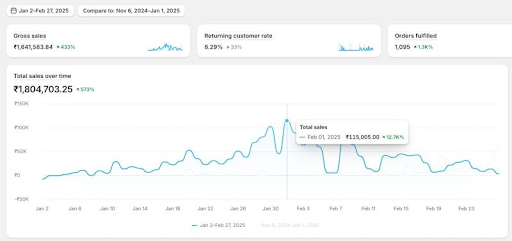
₹0 → ₹10 lakh+ per month — built from zero, no prior D2C history
3 orders in Week 1 → 247 orders in a single week (by Jan 24–30, six weeks after launch)
20–30 orders per day run rate established by late January 2025
₹4,02,150 revenue in one week (Jan 24–30) — all from paid digital, zero D2C history before December
₹78,000 in a single day — largest single-day revenue (March 11, 2025)
Meta ad account restoration in under 48 hours with zero sustained campaign downtime
Compression Backpack hitting 6.5x ROAS on winning offer angle (March 27 data)
Ultra Nanofiber Towel holding 2.5–3x ROAS consistently on top-performing creatives
WhatsApp-first retention system fully operational — abandoned cart flows, review collection, post-purchase gifting
April 2025 target: ₹19–20L/month — ₹10L backpacks + ₹6L towels + ₹3–4L compression gear and accessories
LESSONS FOR SIMILAR BRANDS
Amazon validation is not a business — it's a starting point. Travel Likes Me had strong Amazon traction before Arlox. But Amazon customers belonged to Amazon. Building D2C was about owning the customer: first-party data, WhatsApp relationships, email lists, website reviews. The Amazon channel proved the product worked. The D2C channel turned product buyers into brand loyalists.
Find your hero product before you scale the catalog. Starting with ten SKUs in active ads is tempting — but it dilutes spend and clouds learning. The Ultra Nanofiber Towel became the anchor that funded everything else. Its consistent ROAS bankrolled the testing of backpacks, compression gear, organizers, and accessories. One winning product carries the whole portfolio.
A leaking funnel beats every ad optimization. Week one's 80 add-to-carts with 3 purchases wasn't a targeting failure. It was a checkout, trust, and CRO failure. Fixing the website — reviews, checkout, descriptions — was the difference between 3.75% and 21%+ cart-to-purchase rates. Ad budgets are wasted on unoptimized pages.
Daily updates aren't a luxury — they're a compounding advantage. The gap between a good marketing partner and a great one is how often they look at the data. Daily performance reports meant the brand could make inventory decisions, creative briefs, and budget calls with same-day information. Every week without daily reporting is a week of slow-motion guessing.
CHALLENGES WE FACED
Meta ad account disabled mid-campaign (February 2025). The primary ad account was restricted by Meta in early February — no violation, no warning. The timing was particularly frustrating: the brand had just crossed 20–30 orders/day and was in its strongest growth phase. The Arlox team escalated directly to Meta support, kept the founder updated in real-time, and restored the account within 48 hours. Simultaneously, a backup ad account was configured with payment methods attached, ensuring that any future restriction would mean hours of downtime, not weeks.
Hero product sold out at peak demand. The large black Ultra Nanofiber Towel — the single biggest revenue driver — went out of stock in February just as budgets were scaling. The account had built significant learnings around large-towel creatives. When inventory dried up, spend was temporarily redirected to medium towels and bundles, both of which underperformed against the large towel benchmark. The team managed the dip by using the medium towel creatives as a testing ground for new hooks, preparing the account for recovery when large inventory was restocked.
ROAS dilution during product expansion. When four new SKUs (HydraMate water bottle, Aqua Dry bag, 3-piece bucket organizer, compression pocket) were added to active campaigns simultaneously, the account's overall ROAS dipped temporarily as each new campaign entered its learning phase. The team managed this by maintaining the towel as a ROAS anchor — keeping proven campaigns stable and well-funded while new products were tested at controlled daily budgets (₹2K–₹4K/day to start).
Bundle vs. Magic Checkout conflict. The bundle plugin used for "Weekender Trip-Ready" and "Tripper Travel System" products wasn't compatible with Razorpay Magic Checkout — a critical checkout tool that reduces drop-offs significantly. The team ran A/B tests to quantify the conversion impact before committing to any permanent change, ensuring the fix didn't create a new problem elsewhere in the funnel.
BELIEFS CHANGED
"We need Amazon to survive." The founder came in with Amazon as the primary revenue channel and D2C as a side project. Within six weeks, the D2C channel was generating ₹4L+ per week from paid ads alone — with owned customer data, WhatsApp relationships, and a review engine that Amazon could never provide. Amazon proved the product. The D2C channel built the brand.
"You can't scale a catalog without knowing what works." The brand had multiple strong products but no way to prioritize. The systematic testing approach — launching each SKU with a controlled budget, letting data decide the winner, then scaling that winner while others earned their place — compressed years of product-market learning into weeks. The towel didn't win because anyone guessed it would. It won because the data said so.
"Scaling fast means burning money." The brand's most dramatic growth happened during the periods of highest discipline: daily ROAS monitoring, immediate budget cuts on underperformers, and decisive reallocation to winners. The result was 247 orders in a week from a standing start, with specific ad sets hitting 6.5x ROAS — proof that speed and profitability aren't mutually exclusive when daily data drives every decision.
Kaushal Sharma
Founder
Before
0 MRR
After
10 Lakh MRR
