How Amrit Dawani Scaled From ₹40K to ₹9L/Month — After Discovering Three Months of Ads Had Been Running Without Conversion Data
BRAND SNAPSHOT
Industry: D2C fashion (India)
Category: Premium menswear — handpainted shirts, hand-embroidered kurtas, sherwanis, Indo-western sets, Indian shoes
Geography: India (pan-India, Shopify — amritdawani.com), with international testing in US and UK
Stage: ₹40K/month → ₹9L/month
Services: Meta Ads, Creative Strategy, Technical Infrastructure Audit, Checkout Tracking Fix, COD Management, Audience Management, Creative Copywriting
AOV: ₹7,826–₹12,733
THE PROBLEM
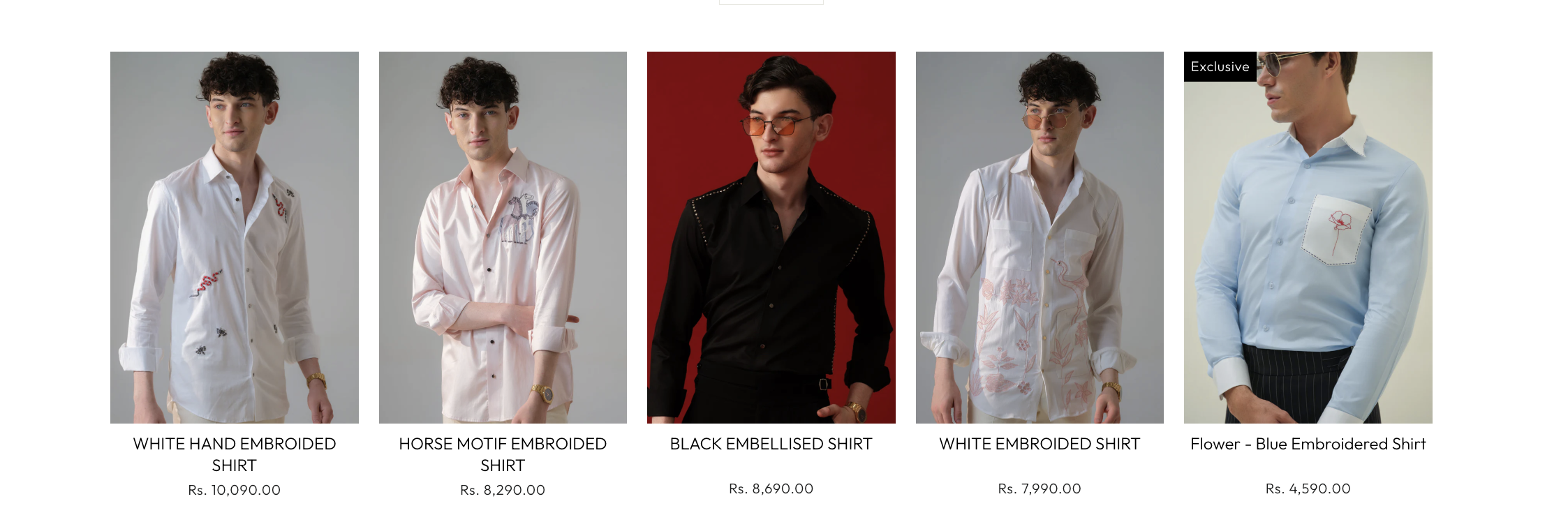
Amrit Dawani had the product. Hand-embroidered shirts. Handpainted statement pieces. Kurta sets and sherwanis positioned deliberately between Manyavar and Manish Malhotra — accessible luxury for the Indian man who wanted something genuinely crafted, not produced at scale. The average order was between ₹7,000 and ₹12,000. Each piece was made to order. Return rate was negligible because there was nothing generic to return.
The founders knew what they had. They had tried digital advertising before — a previous marketing partner had run campaigns on their behalf — but the ad account data was now inaccessible. A phone number tied to an old device. Accounts no longer reachable. Creatives that had run but left no recoverable history. The brand arrived at the start of the engagement with ₹40K/month in total revenue — most of it through offline relationships, marketplace listings, and word-of-mouth from existing clients. Digital had contributed almost nothing. The founder's one-word description of the marketing situation: Disorganized.
The goal was specific. Hit ₹9L/month from digital. Build a foundation for ₹1 crore. The ambition was real. What was missing was an advertising infrastructure that actually worked.
WHY IT WAS HAPPENING
Three separate problems were compounding on each other — each making the others harder to isolate and fix.
The pixel was blind to every purchase. The brand was using a third-party checkout to handle transactions. What wasn't visible at the start of the engagement: that checkout wasn't correctly transmitting purchase events back to the Meta pixel. Every sale that completed was invisible to the advertising algorithm. Conversion campaigns were running — but with no conversion signal. The algorithm was spending money while optimizing for reach and clicks, not buyers. Weeks of ad spend accumulated with the system no more trained on what a real customer looked like than it had been on Day 1. When the Arlox team identified the discrepancy — ads spending, checkout showing sales, Meta ads manager showing almost nothing — the problem's cause became clear. The checkout and the pixel were disconnected at the data layer. Multiple escalations followed: support tickets, direct contact with the checkout provider's team, eventually reaching the provider's founder directly. The fix took more than six weeks to fully resolve.
Payment disruptions were resetting the algorithm's learning every few days. When Meta's billing system caught payments in processing — which happened repeatedly across the engagement — ads would pause for 12–24 hours while the payment cleared. In a bidding system, that pause costs more than those hours. Competitors move into the ad placements. The algorithm loses its audience calibration. When ads resume, they restart the learning phase — a 4–7 day process before performance returns to where it was before the disruption. Every billing hiccup was undoing weeks of optimization. The Arlox team described this precisely in a message to the founders: "It's like building a ship, launching it, and dragging it back to shore over the weekend — only to repeat." Maintaining a 7-day prepaid buffer in the ad wallet, creating a second backup ad account, and monitoring balances daily became as important as any creative decision.
COD orders were training the algorithm to find the wrong buyers. When cash-on-delivery was available, a portion of orders placed were not genuine — they were exploratory orders from buyers with no commitment to follow through. Thirty-two percent of COD orders were cancelled after dispatch. For a made-to-order brand holding inventory against each order, that was an operational problem. For advertising, it was a signal problem. The algorithm had been learning to find people who expressed purchase intent but didn't actually buy. The pixel's audience model was built on bad data. Once COD was disabled and the purchase signal shifted entirely to prepaid transactions, the algorithm's targeting had to be recalibrated — a 7–10 day adjustment period before the new signal stabilised.
THE SOLUTION
Mythos — Creative Advantage:
The brand's creative challenge was different from most. Amrit Dawani wasn't selling a low-consideration product. An average order was ₹7,826 to ₹12,733. The customer needed to be moved, not just reached. Three creative angles anchored the campaign work: Promotional (welcome offer, first-buyer discount), Product Focus (specific pieces shown in close-detail context), and an Elegance angle that positioned the garments in aspirational menswear territory without overclaiming.
The breakthrough was founder content. When the founders appeared in videos — speaking to the craft, the embroidery process, the origin of a design — hold rates increased measurably. Engagement deepened in ways product photography alone couldn't achieve. For a brand built on handmade artisanal menswear, the founder's presence in a video wasn't a personality play — it was the most direct proof of authenticity available. No static image could communicate what a 30-second founder video could: that this piece was made by someone who knew exactly what they were making and why. The creative brief evolved to reflect this: more founder-led content, less generic product reel.
Dynamic catalog ads — which automatically displayed the most relevant product to each viewer based on their interests and browse behavior — allowed the team to identify which SKUs were resonating across different audience segments without requiring dedicated new creatives for every test. The catalog structure became the discovery layer: find the winners efficiently, then build dedicated video and static creatives around the proven products.
Sentinel — Scientific Media Buying:
Infrastructure came first. No scaling decision was made until each bottleneck in the delivery pipeline was eliminated.
The checkout tracking fix was the first priority. Once the team confirmed that purchase events weren't arriving in the pixel, the problem was escalated at multiple levels — tickets to the provider's support team, direct outreach to their leadership — until the connection was restored. From the day of confirmed resolution, campaigns began accumulating real purchase data for the first time. The algorithm could now see what it was producing. The handpainted shirts campaign launched in the weeks immediately following and hit 3x ROAS without any other changes. The product had always been strong. The data channel had not.
Payment continuity required building a parallel funding structure. Shifting from card-only payments to prepaid wallet top-ups maintained 7+ days of ad spend in the account at all times. A second ad account was set up as a backup so that when payment issues occurred in the primary account, delivery could continue uninterrupted through the backup. This wasn't an abundance of caution — it was the minimum required to keep the algorithm's learning phase intact across the disruption-prone payment environment.
Once infrastructure was stable, the media-buying focus narrowed: shirts first. Not kurtas or sherwanis, not the full catalog — shirts. Shirts had the clearest creative library, the most trained pixel data, and the lowest purchase friction for new buyers. The philosophy was explicit: establish one stable, profitable acquisition channel before expanding the product portfolio. When shirts reached 3x ROAS, the foundation for scaling other categories would be in place. Budget decisions were made on a daily cadence. When performance held, daily spend increased 7–8% incrementally. When disruptions hit, budgets were cut back rather than maintained — protecting the learning that had accumulated.
The ROAS floor was defined jointly: 3x minimum, no exceptions. When the account fell below that threshold — due to payment disruptions or account shifts — campaigns were paused rather than continued at a loss. Discipline over volume.
Vault — Brand Value Engine:
Amrit Dawani's positioning required protecting at every touchpoint. The brand wasn't competing on price — it was competing on craft. Hand-embroidered, made-to-order, ₹7K–₹12K+ per order. Everything communicated had to reinforce that this was genuinely artisanal menswear, not fast fashion with a premium label.
The welcome offer (15% off for first-time buyers) was structured to attract genuine customers rather than discount hunters. When COD was removed and the offer became prepaid-only, the quality of the buyer intent improved further. Coupon code consistency across ad creative, product pages, and checkout was maintained specifically to prevent trust breaks — a buyer who saw one discount and encountered a different one at checkout would question the whole experience.
For international buyers in the US and UK markets, the team tested an approach of using WhatsApp-based consultation for high-value orders — a human-touch alternative for customers who couldn't rely on marketplace trust signals. This was consistent with the brand's made-to-order identity: not a transactional brand, but one where the relationship between buyer and maker was part of the product itself.
THE RESULTS
₹40K/month → ₹9L/month — total revenue growth across the engagement (22x)
Handpainted shirts: 3x ROAS immediately upon campaign launch after checkout tracking was restored — the cleanest evidence that the product had always been the strongest asset and the infrastructure was the only thing blocking it
₹46,955 revenue in a single week (Nov 8–14) on ₹15,676 in ad spend — 3x ROAS (300%) — the first clean, uninterrupted high-performance week
₹63,663 revenue the following week (Nov 15–21) on ₹28,059 in ad spend — the highest ad-attributed revenue week in the engagement
₹17L in total sales in the first three months of active campaigns (July–October) — achieved even while major infrastructure problems were being resolved in parallel
AOV: ₹7,826–₹12,733 across high-performing weeks — the premium positioning held at full price points with no need to discount down
3x ROAS floor established as the campaign standard — a commitment from both the brand and the team that aligned execution discipline with growth expectations
LESSONS FOR SIMILAR BRANDS
If your checkout and your pixel aren't talking, your campaigns are guessing. The most expensive mistake in performance marketing isn't bad creative or wrong audiences — it's running conversion campaigns when the conversion signal isn't reaching the algorithm. Before testing any new angles or scaling any budgets, verify that every purchase completing through your checkout is registering as a purchase in your ads manager. If there's a discrepancy between what your checkout dashboard shows and what your ads manager shows — find it and fix it before spending another rupee. Three months of misdirected optimization is difficult to undo.
For high-AOV brands, payment continuity matters as much as creative quality. When your average order is ₹7,000–₹12,000, the volume you need for healthy ROAS is lower than a ₹500 product — but every disruption to ad delivery costs more per lost day. A payment processing failure that pauses ads for 12 hours and resets the algorithm's learning phase is expensive not in the money paused, but in the momentum lost. Maintaining a 7-day ad spend buffer in the wallet isn't a financial choice — it's a technical requirement for the algorithm to function correctly.
COD fake orders are a data quality problem before they're a logistics problem. High COD cancellation rates don't just create inventory headaches. They train your algorithm to find people who express purchase intent but don't follow through — and once those buyers are overrepresented in your pixel's audience model, every campaign is optimizing toward the wrong customer. Moving to prepaid-only produces a sharper, more honest audience signal. Your ROAS may dip for 7–10 days during the recalibration. It comes back stronger because the algorithm is now building on real buyers.
Founder content is a competitive moat for premium artisanal brands. When you're selling a ₹8,000–₹12,000 piece — a kurta for a wedding, a shirt for a statement occasion — the buyer is asking "can I trust the person behind this?" before they ask "is this piece beautiful?" A founder who appears in video, speaks to the craft, shows the embroidery work, explains why a design exists — that is an advertisement no budget allocation can replicate through generic product photography. If you make something by hand, your presence in the creative is the proof of that claim.
CHALLENGES WE FACED
The checkout tracking issue ran for more than six weeks before full resolution. From the first identification of the data gap to confirmed fix required persistent escalation through multiple layers of the provider's support structure — ultimately requiring direct contact with their leadership. During this entire period, campaigns continued running on incomplete data. The below-ROAS results of the first two months were partially a direct consequence of this invisible infrastructure failure, not of campaign quality. It was impossible to know how much better performance could have been during those weeks.
Meta payment processing failures in India were systemic and recurrent. Multiple times across the engagement, payments were caught in 24-hour processing states that paused ad delivery. This was acknowledged by Meta representatives as a broader India-market issue during this period — but it created compounding damage each time. The solutions (prepaid wallet, backup ad account, daily balance monitoring) worked, but building this parallel payment infrastructure was an operational overhead that consumed significant attention.
COD removal caused a temporary performance dip that was difficult to manage under pressure. When COD was disabled and the audience model had to recalibrate, performance dipped below the 3x ROAS threshold for 7–10 days. This was an expected, manageable adjustment — but it was difficult to communicate as such when the brand was already frustrated by prior performance gaps. Explaining that things would get temporarily worse before they got better, during a period when the brand was already concerned, required careful expectation management.
The previous ad account history was completely inaccessible. The prior marketing partner had run campaigns on accounts that were now unrecoverable. No historical creative performance data, no audience insights, no conversion baseline. The engagement began from a fresh pixel with zero history, which extended the warmup period significantly compared to a brand with trained campaign history.

Amrit
Founder
Before
40k MRR
After
9L MRR
